Sustained reforms key to maintaining Vietnam’s growth momentum: WB

Despite mounting short-term external challenges, Vietnam’s medium-term economic outlook remains highly positive, with the country expected to continue as one of the region’s growth bright spots.

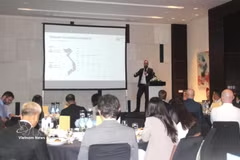
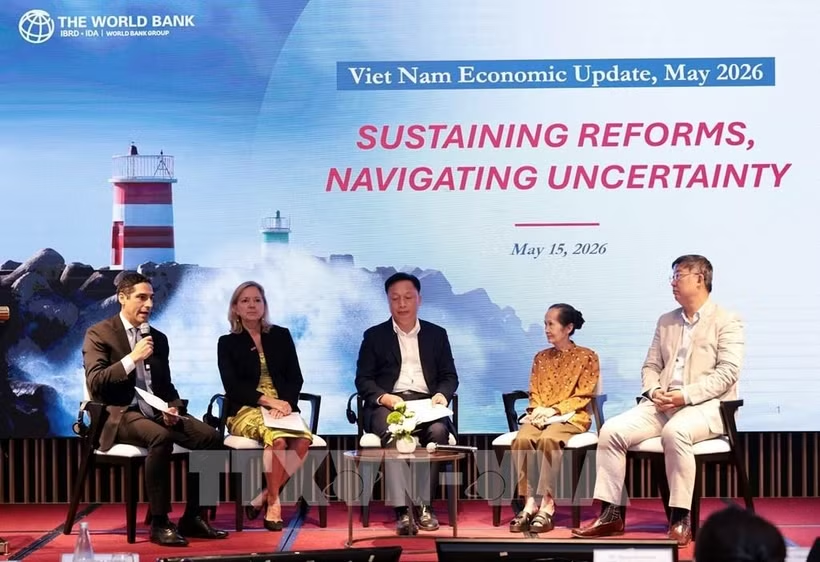
Speakers at the press conference (Photo: VNA)

Hanoi (VNA) – Despite mounting short-term external challenges, Vietnam’s medium-term economic outlook remains highly positive, with the country expected to continue as one of the region’s growth bright spots, according to the World Bank (WB)’s latest Vietnam Economic Update.

Speaking at a press conference to release the report on May 15, WB Division Director for Vietnam, Cambodia and Laos Mariam J. Sherman said Vietnam entered 2026 from a position of strength, outperforming other economies in the Association of Southeast Asian Nations (ASEAN).

Despite global trade headwinds, Vietnam’s gross domestic product (GDP) expanded by 8% in 2025, the highest growth rate in ASEAN, driven by strong export performance, a resilient services sector, and rising foreign direct investment (FDI) inflows and public investment. The momentum has also been supported by an ambitious reform agenda aimed at restructuring the state apparatus, described as the most far-reaching since the Doi moi (Renewal) period.

According to Tamina Khan, WB Lead Economist for Vietnam, Cambodia and Laos, Vietnam is also benefiting from the global artificial intelligence (AI) investment boom, with exports of AI-related products now accounting for nearly 30% of GDP.

However, the external environment has become more challenging in 2026. Global trade uncertainty persists, while US tariffs remain higher than pre-2025 levels, putting pressure on highly open economies such as Vietnam. At the same time, conflict in the Middle East has triggered severe oil supply disruptions.

The WB said these pressures are exposing four structural weaknesses in Vietnam’s growth model.

First, the gap between domestic enterprises and FDI firms is widening. Since the announcement of US reciprocal tariffs, exports from the FDI sector have surged by 42%, while exports from domestic firms have contracted due to a weaker capacity to absorb tariff shocks.

Second, despite strong trade growth, Vietnam’s foreign exchange accumulation remains limited, resulting in thinner reserves and prolonged exchange rate pressure.

Third, Vietnam’s corporate leverage ratio is among the highest in the region, while liquidity strains persist in the banking sector. Khan noted that Vietnam’s credit-to-GDP ratio reached 145% in 2025, the highest in ASEAN, while Vietnamese banks maintain thinner capital buffers than regional peers.

Fourth, concerns remain over the efficiency of public investment. With a planned investment package of 320 billion USD for 2026–2030, the challenge for Vietnam is not how much to spend, but how to spend effectively to generate productivity gains.

Against this backdrop, the WB projected Vietnam’s economic growth to moderate to 6.8% in 2026 before recovering in 2027–2028 as oil supply shocks ease and domestic growth drivers strengthen. Average inflation in 2026 is forecast at 4.2%, assuming second-round inflationary impacts remain under control.

Despite heightened short-term risks, Khan stressed that Vietnam’s medium-term outlook remains positive. She said effective implementation of reforms would help the country overcome external challenges and maintain strong growth momentum.

The WB recommended that Vietnam ensure rigorous appraisal and effective implementation of its 320-billion-USD public investment portfolio, diversify long-term financing sources beyond the banking system, and improve the quality of FDI by strengthening linkages with domestic firms and promoting knowledge transfer.

Sherman noted that Vietnam is pursuing some transformative reforms, but stressed that their full impact would depend on effective implementation, making policy execution and commitment to the reform agenda crucial at this stage./.
VNA

See more

A view of the Government's regular meeting for May on June 3, 2026 (Photo: VNA)

Deputy Minister urges tougher accountability for delayed national target programmes

Speaking at the Government’s regular press conference for May on June 3, the Deputy Minister acknowledged that implementation and disbursement of national target programmes, as well as public investment projects in general, remain slower than expected despite repeated reviews by the Ministry of Finance, relevant ministries and localities.

A graphic image of Song Lo I Industrial Park in Phu Tho province (Photo: VNA)

FDI inflows into Phu Tho surge 3.5-fold in first five months

As of May 20, Phu Tho province had granted investment licences to 15 new FDI projects with total registered capital of 307.2 million USD. Investors from Japan, the Republic of Korea, Taiwan (China) and China continued to select Phu Tho as an investment destination, with China taking the lead in the number of newly licensed projects.

Traders purchase tuna at a fishing port. (Illustrative photo: VNA)

Aquatic products face challenge of maintaining market share in US

According to the Vietnam Association of Seafood Exporters and Producers (VASEP), the US National Oceanic and Atmospheric Administration (NOAA) has recently recognised Vietnam’s crab fishery as equivalent to US standards. Under an updated decision issued in last month, Vietnamese crab and crab products will continue to be eligible for import into the US market.

At the working session (Photo: thoibaotaichinhvietnam.vn)

TikTok interested in investing in logistics, digital finance in Vietnam

Deputy Minister of Finance Cao Anh Tuan commended TikTok’s rapid growth and its contributions to Vietnam’s digital economy. With tens of millions of users, TikTok has become not only a platform for content creation and social interactions but also an effective tool for product promotion, market expansion, and e-commerce.

A view of the business seminar on upgrading Vietnam’s industrial sector through Nordic expertise and partnership held in Ho Chi Minh City on June 3, 2026. (Photo: VNA)

Vietnam to become one of Asia’s leading high-value manufacturing hubs: seminar

Vietnam is now on the threshold of becoming a leading manufacturing hub for both global and ASEAN markets, with the potential to position itself as one of Asia’s foremost high-value manufacturing centres. However, the country is also facing increasing competition from regional economies such as Malaysia, Indonesia and India.

Imports and exports are handled at Lach Huyen container port in Hai Phong city. (Photo: VNA)

Trade turnover exceeds 445 billion USD in five months

In May, Vietnam's trade turnover amounted to 99.07 billion USD, rising 3.2% from the previous month and 25.8% from a year earlier. Exports increased 19.5% year-on-year in the January-May period, while imports surged 30.8%.

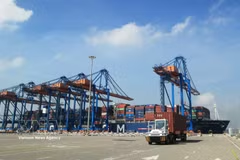
A container truck runs at the Gemalink International Port, part of the Cai Mep port complex, in Tan Phuoc ward, Ho Chi Minh City. (Photo: VNA)

Vietnam seen as ASEAN’s resilient growth bright spot

According to the World Bank (WB), buoyed by impressive GDP growth of 8% in 2025, Vietnam entered 2026 as one of Southeast Asia's strongest-performing economies. In its latest economic update released in May, the WB highlighted Vietnam’s robust fundamentals and favourable growth outlook.

A Xiaomi store in Beijing, China, on January 15, 2021 (Photo: AFP/VNA)

Xiaomi Vietnam fined for violating consumer rights

Xiaomi Vietnam Co., Ltd was fined 290 million VND (about 11,000 USD) for three violations of consumer protection regulations, according to the National Competition Commission (NCC) under the Ministry of Industry and Trade.

Export is one of the important contributors to Vietnam's economic growth. (Photo: VNA)

Vietnam's economy accelerates despite global uncertainties: French report

Vietnam is well positioned to remain among Asia’s fastest-growing economies. Future success will depend on the country’s ability to leverage opportunities from international integration while developing new domestic growth drivers to support its ambition of becoming a high-income economy by 2045.

Hanoi’s consumer price index increased by 0.28% in May compared to the previous month (Photo: VNA)

Hanoi’s May CPI rises 0.28%

The Statistics Office attributed the stable market situation to the city’s efforts to implement Government directives on price governance and inflation control while ensuring adequate supply of goods and services, especially essential ones.